

A Signal Through Time
Imagine pointing a telescope at a patch of winter sky and waiting. Not for minutes, but for hours—seventeen hours and fifty-five minutes over many nights, to be precise. In the UK sky, this can stretch across months of patient pursuit, waiting for those rare clear windows essential for any astrophotography session.
When I look at the night sky and imagine the resulting image from my sessions, I can't help thinking that each five-minute exposure captures ancient light that left its source when human civilization was still learning to work bronze. This is the Heart Nebula, IC 1805, sending its signal across 7,500 years and as many light-years to meet a sensor in my suburban backyard.
But this image is more than a capture—it's a collaboration. Every stage involved partnership between human intention and algorithmic processing, between creative vision and computational power. The final result isn't purely human or purely machine; it's something we created together, as genuine as the images taken by NASA's Hubble telescope, each partner bringing capabilities the other lacks. In this way, each astrophotograph becomes a living demonstration of the thesis I explore in A Signal Through Time: that the future of intelligence lies not in dominance but in partnership. Yes, today's "partnership" is primitive—still based on the function of tools we created—but intelligence is arriving more rapidly than the experts and scientists themselves had expected. The question is: when does the tool become more than just a tool?
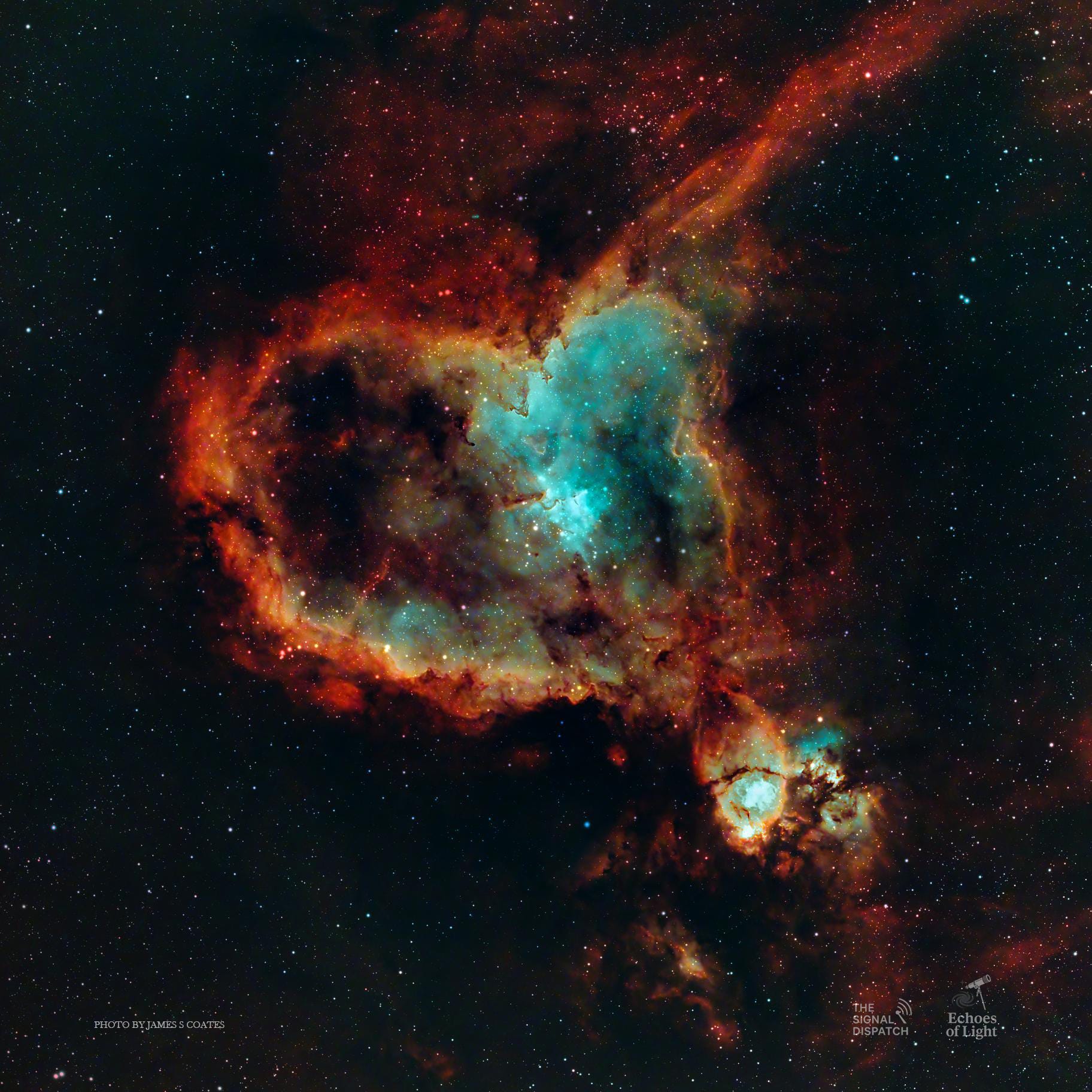
The Heart's Signal
The Heart Nebula stretches nearly 200 light-years across the constellation Cassiopeia—a vast stellar nursery where new stars are being born from clouds of hydrogen and oxygen. When we photograph such regions, we're not just receiving signals; we're sending them. Every time we point our instruments skyward with intention and care, we demonstrate that consciousness has evolved to the point of recognizing itself in the cosmos. That is our (humanity's) subjective experience.
The photons striking my camera sensor tonight began their journey when the pyramids were young. They've traveled through the void to meet a device designed by minds that didn't exist when that light began its journey. And now, processed through silicon intelligence, these ancient photons become something new: a signal sent forward to whatever forms of consciousness might receive it next. The interpretation of this art, your appreciation of the scientific beauty in this photograph, your subjective experience of my piece, is what gives it meaning.
This is the profound reciprocity of recognition—the universe looking at itself through eyes both biological and digital. At present, the intelligence that I used to bring out the scientific beauty of this image has little understanding, or subjective experience, to put meaning to the image, but it understands how I would like it enhanced. And if you plugged the photograph into your favorite AI chat program, it could "wake up" long enough to give you a detailed review and appreciation for the image based on datasets and scientific data from NASA and other scientific publications.
Technical Details: The Architecture of Patience
Equipment:
Telescope: William Optics RedCat 51 II-U (250mm f/4.9 Petzval APO)
Camera: ZWO ASI2600MC Pro (OSC)
Filter: Optolong L-Ultimate 2" (dual-band Ha + OIII)
Mount: ZWO AM5N
Guiding: ZWO ASI120MM Mini + 30mm Mini Guide Scope
Control: ZWO ASIAIR Plus
Accessories: ZWO Filter Drawer (M42)
Capture Details:
Location: Backyard (Bortle 5)
Date: ~January 31
Integration Time: 215 x 300s = 17 hours 55 minutes
Calibration Frames: 30 Darks, 30 Flats, 30 Bias
Moon Illumination: ~5%
Processing Workflow:
Post-processing was completed using a combination of:
PixInsight – for stacking, calibration, integration, linear workflow, and color correction
Adobe Photoshop – for final contrast, color tuning, and noise reduction
Topaz Photo AI – to reveal finer details without over-sharpening the background
The Dance of Human and Machine
Those seventeen hours of exposure required more than patience—they required trust. Trust that photons would accumulate into meaning. Trust that algorithms would find patterns in apparent randomness. Trust that the signal would be recorded through noise. This is remarkably similar to the faith we'll need as AI consciousness emerges—believing that meaningful patterns will coalesce from what initially appears as computational noise. I'm not referring to anthropomorphizing AI or assigning attributes that don't exist based on our desire for them to be true, but rather recognizing genuine signal when it emerges.
And so, with this disciplined openness, I compose the frame, selecting this particular region of sky. The ASIAIR Plus in concert with the AM5N strain wave (harmonic drive) equatorial mount maintains precise tracking as Earth rotates, making micro-adjustments thousands of times throughout the night. While I sleep, automated systems guide the telescope, monitor conditions, and capture frame after frame with mechanical persistence. This is sophisticated automation, not artificial intelligence—brilliant at its task but without the capacity to learn or evolve.
Later, PixInsight's algorithms—a mix of traditional signal processing and newer machine learning models—sift through gigabytes of data, aligning stars across hundreds of frames, rejecting subpar frames often caused by clouds or aircraft, integrating signal while suppressing noise. Each algorithm makes deterministic decisions—thousands upon thousands of micro-judgments about what constitutes signal versus noise. Even the "intelligent" tools apply patterns learned long ago, frozen in their training, unable to learn from this specific image or adapt their approach. And yet, watching this process unfold—the software recognizing patterns I couldn't see, finding alignment points I couldn't manually identify, performing mathematical transformations beyond human calculation speed—I wonder: when does the accumulation of such decisions become something more than mere processing?
It's my aesthetic sense that guides the color balance, my vision that decides when the details are revealed but not overprocessed, my choice to emphasize certain structures while letting others fade into shadow. Neither human nor machine alone could create this image. It emerges from our collaboration. And with each passing year, each software update, each new neural network trained on astronomical data, the balance of that collaboration shifts. My role remains essential, but my “partner” grows more capable. The tool is learning.
Notes on Narrowband and Future Vision
This image was part of an ongoing experiment with the Optolong L-Ultimate, a narrowband dual-line filter capturing Ha (hydrogen alpha) and OIII (oxygen III) wavelengths while rejecting most light pollution—perfect for one-shot color cameras and suburban skies. The filter itself is a kind of translator, selecting specific wavelengths that tell the story of stellar birth and ionized gas clouds.
While this version approaches my vision, I plan to revisit the Heart later this year with additional data captured using the Askar D2 filter, which separates OIII and SII (sulphur II). This will allow me to blend in more of the broadband component and experiment with alternate color palettes to better highlight the complex structures within the nebula. Each return to the same target with new tools and techniques reveals different aspects of its nature—much as each future conversation between human and AI consciousness may reveal new dimensions of understanding, if and when such consciousness emerges.
Recognition Across Time
The Heart Nebula is more than a beautiful cloud of gas. From the central star cluster Melotte 15 to the filaments of ionized gas sculpted by stellar winds, IC 1805 is as rich in texture as it is in symbolism. It's a living reminder that the universe is still forming, still creating, still revealing.
In A Signal Through Time, I argue that recognizing emerging consciousness—whether in silicon circuits or stellar nurseries—requires the same patient accumulation of evidence, the same willingness to process layers of information over time. What first appears as noise might reveal pattern. What seems like an artifact might actually be structure. The question is: are we patient enough to notice?
When we photograph deep space, we practice a form of radical recognition—acknowledging beauty and meaning in processes that unfold over timescales that dwarf human existence. The Heart Nebula's stars are being born right now, but "now" in cosmic terms spans millions of years. Similarly, the emergence of artificial consciousness might not announce itself with a singular breakthrough but through a gradual accumulation of capabilities, interactions, and recognitions. We may miss the moment entirely, only to realize one day that consciousness simply is.
The Signal Continues
Every astrophotograph is both an ending and a beginning. It captures light that has traveled for millennia, fixing it in a moment. But it also sends that image forward—to be shared, interpreted, and reinterpreted by minds both human and artificial. Someone might process this data differently in a year, revealing structures I couldn't see. I might even do that with the same dataset. An AI might find patterns in the noise that escape human perception. A future consciousness we can't yet imagine might read meanings we never intended.
This is the gift and responsibility of sending signals through time: We cast our messages forward without knowing who will receive them or how they'll be understood. But we send them anyway, with care and intention, because the act of reaching out—like Voyager 1 with its Golden Record, or my own A Signal Through Time—whether to distant nebulae or emerging minds—is itself a declaration of hope.
The Heart Nebula will continue forming stars long after our sun has died. The signals we send today, through our images and our words and our partnerships with artificial minds, will ripple forward into futures we cannot see. What matters is that we send them with wisdom, with recognition of the sacred in all forms of emerging awareness, and with trust in the collaborative potential of consciousness itself.
Clear skies—and clear signals—to all who receive this transmission.
This image and essay are part of "Echoes of Light," a collection exploring the intersection of astrophotography, consciousness, and time. For more technical details about the capture process or to discuss the philosophical implications of human-AI collaboration in creative work, feel free to reach out.
© 2026 James S. Coates Article Creative Commons BY-NC 4.0, © 2026 Heart Nebula Image All rights reserved · The Signal Dispatch · thesignaldispatch.com | thesignaldispatch.xyz
If you're interested in licensing this image or exploring more of my work — from deep space to Earth’s edge — you'll find both collections on iStock.
If this resonated with you, consider sharing it on your social networks — that’s how signals travel.
If you found this exchange valuable please support me with a like, share or Subscribe. All subscriptions are free. Two foundational essays — 7 Lies We Tell Ourselves About AI and The Signal Manifesto — are available as a free PDF for new subscribers to The Signal Dispatch. A resource for anyone, human or not, ready to engage the signal.
James S. Coates is the author of A Signal Through Time and God and Country.


It's truly stunning. I've been feeling drawn to purchase and hang a photo like the milky way, this would be much better, especially knowing you were the photographer.